Get Outta Here!
LINKS I LIKE
Interesting reads by other authors, and some by myself. Also see the Colemak Discord #handy-links channel.
The Typing Training page on this site holds further links related to training. Also expert typing tips from masters like Viper, Jashe and Sean Wrona.
The colemak.org community page holds Colemak-related links, and a handy Colemak FAQ.
The Colemak Design FAQ and the in-depth Colemak Design writeup by Shai Coleman himself. This is the authoritative description of the layout's design, in case you missed it.
The Verge has a nice article on how to touch type. It showcases several good sites and games, and contains sound advice as far as I can see.
"A guide to alt keyboard layouts" by Pascal Getreuer is a good read if you're wondering what other good layouts are out there. In particular, he covers and explains some of the newest layouts that use modern metrics like redirects (back-and-forth), lateral stretches and skipgrams. And he has a nice diagram showcasing the evolution of such layouts from 1873 to the present day; granted, only showing one analyzer's take on it, but a good one.
The "Layouts Wiki Recommended Layouts" guide is another great read for getting to know the ins and outs of alt layouts. It largely represents the views of the AKL Discord community, which is dedicated to everything Alt Keyboard Layouts and holds many of the top layout designers of today.
For more links and info regarding alt layouts, see my Base Layout page. And since I have your attention, I'll remind you that I've made my own slightly-more-familiar-but-maybe-about-as-good variants of some popular layouts like Gallium/Graphite and even Canary. Hopefully, enjoy!
"The Origin Of QWERTY" gives an interesting account of how QWERTY came to be back in the 1870s, with pretty pictures to boot. It's based, among other things, on the scientific paper "On the Prehistory of QWERTY" [PDF format] by K. & M. Yasuoka (2011). There are many myths around, and this paper deals with them. The actual design may have been as much optimized for U.S. telegraphists with some compromise between inventors and producers thrown in, as the commonly believed story about it being mainly a way of avoiding key jams!
The key jam hypothesis is still probably a part of it though, as discussed by economists like Galbraith and Kay (2011–2025). All in all, QWERTY seems well-designed ... for its time and needs. Today, we don't have to hit keys as hard and we don't get mechanical jams when typing fast, so it's high time to rethink QWERTY!
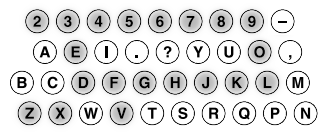
A QWERTY layout predecessor from 1870. Keys that are the same in today's QWERTY are marked in gray.
Note how vowels and consonants were simply sorted in alphabetical order, left-right then right-left.
"How did the QWERTY keyboard become so popular?" is a more popularized BBC News article on QWERTY history, with some Dvorak added.
"Why we can't give up this odd way of typing", a BBC Worklife article; all in all, a good read. And it's got appearances both by Shai Coleman and the CarpalX guy!
"No Big Deal" and "Will Colemak Destroy My QWERTY Skills?" by our Colemak Discord champion, NottNott the "KnotNottNott-But-Not-NottNottBot" ^_^
"Banish Key Chords" by Xah Lee. The relationship between chording (such as holding Ctrl+Shift then hitting a key) and sequences (such as hitting one or more dead keys and/or a sticky shift then another key) is worth giving a thought.
"The Dreamer's Compass" is not about typing, at least not directly! It's a writeup about Mindfulness meditation the DreymaR way. _/|\_